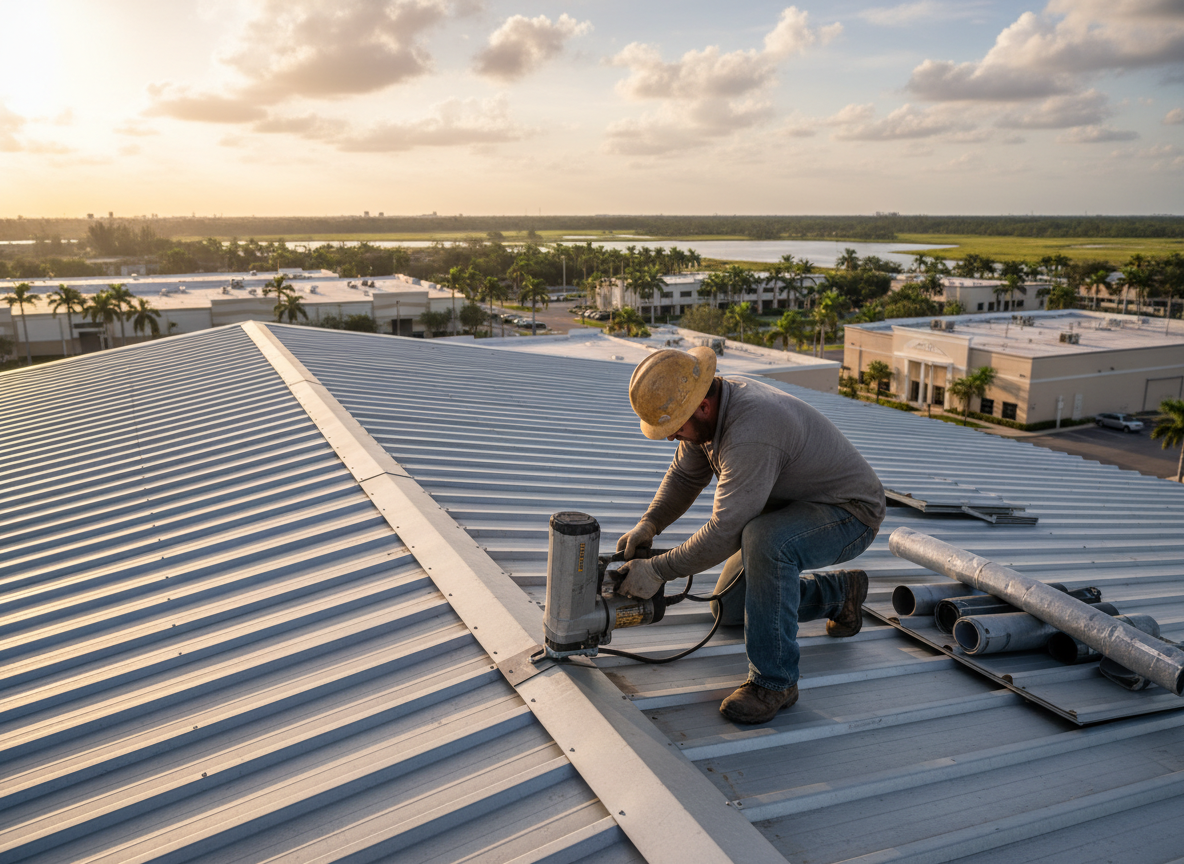
Industrial roofs in Tamarac often cover large flat or low-slope structures on warehouses and manufacturing sites built from the 1970s onward. These buildings sit in a subtropical climate where daily UV bombardment cracks single-ply membranes while afternoon thunderstorms dump several inches of rain in an hour. Wind codes in Broward County now require enhanced edge details and fastener schedules that older installations frequently lack, turning minor leaks into widespread deck damage once water reaches the insulation layer.
Common failures here include seam separation on TPO and EPDM after repeated thermal cycling and ponding water that collects because original drains were never sized for today’s heavier rainfall events. Metal deck corrosion accelerates near the coast when salt-laden air meets condensation under poorly ventilated systems. Proper work demands removal of saturated insulation, verification of deck attachment to meet current wind-load tables, and installation of cover boards that prevent future blistering.
Contractors must also coordinate around active operations, staging materials so forklifts and delivery trucks keep moving. Night or weekend shifts are common to avoid disrupting production lines. Detailing around HVAC curbs, skylights, and penetrations requires extra care because any shortcut shows up quickly during the next tropical storm.
Selecting the right membrane or modified bitumen system depends on the building’s thermal profile and future maintenance access. Reflective coatings help cut cooling loads, yet they must be reapplied on schedule or the underlying material degrades faster than expected in Tamarac’s constant heat.
Technician insight
In Tamarac, the thing that catches most people out with Industrial Roofing is how quickly ponding water develops on flat decks when original scuppers sit too high after multiple re-roofs; once insulation saturates, the deck rusts from below and you lose the whole section before the next dry season.
Warehouse Roof Leak Near Commercial Blvd
A distribution center on W Commercial Blvd reported repeated leaks around HVAC curbs after summer storms. We found saturated polyiso under a ten-year-old TPO membrane where seams had opened from thermal movement. We removed the wet sections, added tapered insulation to improve drainage, and installed a new 60-mil TPO with reinforced perimeter details. The facility stayed operational throughout the phased work.
How it works
- 1
Site Assessment
Measure the roof, document existing conditions, and test for moisture intrusion with infrared scans.
- 2
Code Review
Check current Broward County wind-load requirements and specify edge details and fastening patterns accordingly.
- 3
Material Selection
Choose membrane or built-up system suited to the building’s slope, drainage, and exposure.
- 4
Installation
Remove wet materials, install new insulation and cover board, then apply the roofing system with all penetrations flashed.
- 5
Final Walk-Through
Verify seams, drains, and edges, then provide maintenance recommendations for the owner.
Pricing
Pricing varies by roof size, existing condition, chosen system, and access constraints; contact us for a site visit and written scope.