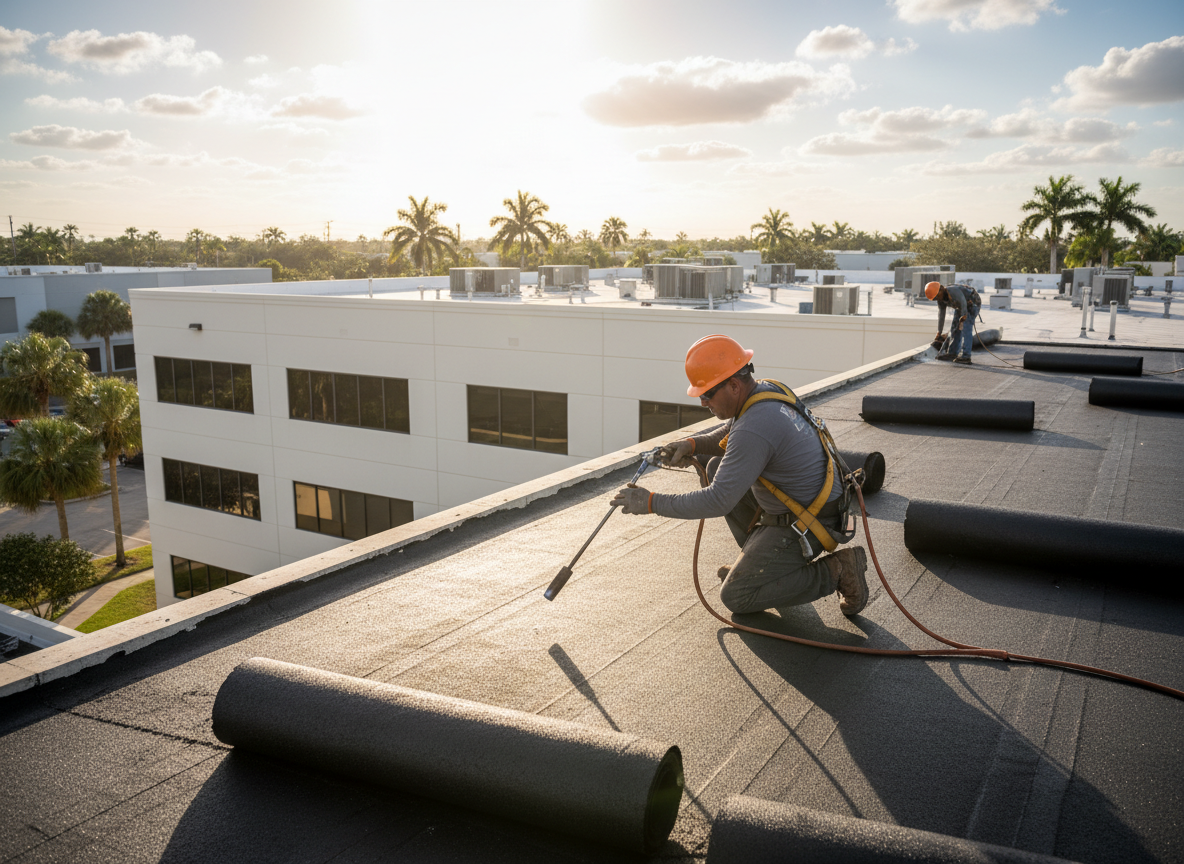
Commercial buildings in Tamarac often feature flat or low-slope roofs on strip malls and offices along Commercial Boulevard. These surfaces demand membranes such as TPO or EPDM that resist UV degradation and ponding water common during afternoon thunderstorms. Installers must account for the Florida Building Code wind-load requirements that increase fastening schedules near the coast in Broward County. Poor slope or clogged scuppers quickly lead to leaks that damage tenant spaces below.
Edge cases appear when older Tamarac retail centers receive tenant fit-outs that add HVAC units without proper curb flashing. Each penetration becomes a leak point if the membrane is not reinforced and sealed to handle thermal expansion from intense sun. Crews also watch for foot traffic patterns from maintenance workers that abrade the surface over time. Matching existing insulation layers prevents condensation issues inside the building during humid summer months.
Drainage design is critical because Tamarac sees sudden heavy downpours that overwhelm undersized leaders. Technicians verify that modified-bitumen flashings at parapets remain flexible after years of exposure. When re-covering rather than tearing off, existing wet insulation must be located and removed to avoid trapped moisture that blisters the new membrane. These steps protect the investment for properties serving neighborhoods from Woodlands to the Tamarac city limits.
Technician insight
In Tamarac, the thing that catches most people out with Commercial Roofing is how older flat roofs on buildings near Commercial Boulevard pond water after summer storms when scuppers clog with leaves from nearby trees; missing one clogged drain during inspection turns a membrane job into repeated callbacks.
Tamarac Strip Mall Membrane Repair
A retail center along W Commercial Blvd showed repeated interior leaks after thunderstorms. Inspection revealed ponding at clogged scuppers and failed flashings around HVAC curbs. We replaced wet insulation sections, installed new TPO membrane with reinforced seams, and cleared all drains. The roof has remained dry through multiple rainy seasons.
How it works
- 1
Site Assessment
Technicians examine the entire roof surface, check drainage paths, and note any penetrations or prior repairs on Tamarac commercial properties.
- 2
Material Selection
Crew reviews wind ratings required by local code and selects membrane type suited to the building's slope and sun exposure.
- 3
Preparation and Repair
Old damaged sections are removed, wet insulation is replaced, and substrate is prepared before new membrane installation begins.
- 4
Installation and Testing
Membrane is installed with proper seams and flashings, then flood-tested or scanned to confirm watertight performance.
- 5
Final Walkthrough
Owner receives documentation of work performed and maintenance recommendations specific to South Florida weather cycles.
Pricing
Upfront quotes follow on-site measurement; final cost depends on roof size, existing condition, and chosen membrane system.